

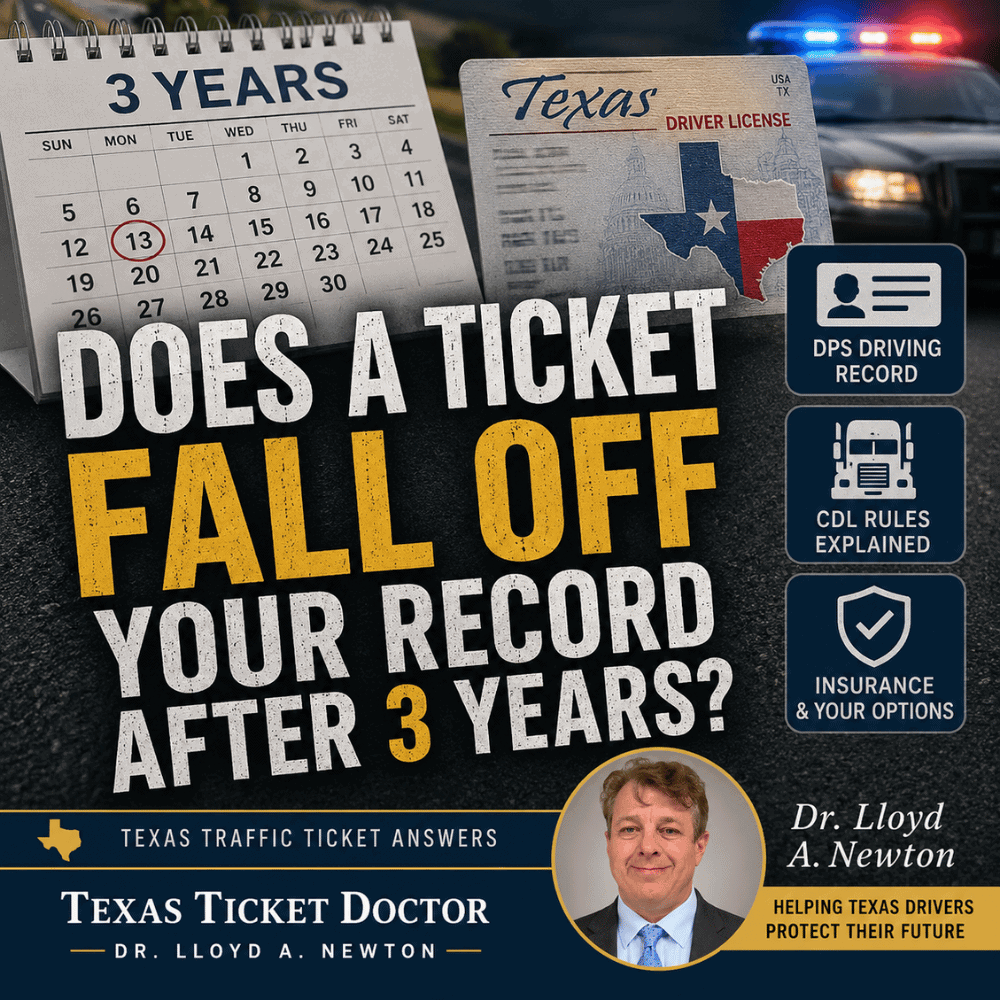
I hear this question from Texas drivers all the time: “Doesn’t a traffic ticket fall off my record after three years?”
The answer is not necessarily.
The confusion comes from the word “record.” There is more than one record that may contain information about a traffic ticket, and different organizations look at different time periods. Three years is a real number in several traffic and CDL rules, but it usually doesn’t mean the conviction has been erased.
If you received a traffic ticket in Texas, I wouldn’t recommend assuming you can simply wait three years and make it disappear. Understanding what happens before you pay the ticket can make a big difference.
Does a Texas Traffic Ticket Disappear From Your DPS Driving Record After Three Years?
No. The three-year misconception often comes from the type of Texas driving record people request.
The Texas Department of Public Safety offers several types of driver records. A Type 2 driving record is specifically described as a three-year history. It includes moving violations for three years from the date of the offense. A Type 2A is simply the certified version of that three-year record.
That means you could order a Type 2 record after enough time has passed, notice that an older ticket is no longer listed, and reasonably assume the ticket has “fallen off.”
But that is not what happened.
Texas DPS also offers a Type 3 driving record, which lists all crashes and moving and nonmoving violations contained in the record. A Type 3A is the certified version. DPS also offers a Type AR, which is described as the certified abstract of the complete driver record and includes Type 3 information plus suspensions.
In other words, a ticket disappearing from a three-year report does not necessarily mean the underlying conviction disappeared.
That distinction is extremely important.
What Happened to the Old Three-Year Texas Points System?
Another reason people remember the three-year rule is Texas’ former Driver Responsibility Program.
Under that old system, drivers could accumulate points for certain moving violations, and those points were associated with a rolling three-year period.
But that program no longer exists.
Texas repealed the Driver Responsibility Program effective September 1, 2019. DPS confirms that the program was eliminated and that the surcharge system tied to it was discontinued.
So if someone tells you that you can just wait for your Texas traffic “points” to fall off, they may be remembering a system Texas stopped using years ago.
Today, the more important question is whether the traffic ticket results in a conviction in the first place.
Do CDL Tickets Fall Off After Three Years?
If you hold a commercial driver’s license, the three-year rule matters even more, but it still doesn’t mean the ticket disappears.
Federal and Texas CDL rules use three-year lookback periods for certain violations.
For example, Texas DPS states that two serious traffic offenses within three years can result in a 60-day CDL disqualification. Three serious traffic offenses within three years can result in a 120-day disqualification. Examples may include excessive speeding, reckless driving, improper or erratic lane changes, and following too closely.
The key phrase is within three years.
The three-year period determines whether violations can be counted together for purposes of a disqualification. It does not mean the first conviction magically disappears when the third anniversary arrives.
For a CDL driver, that distinction can affect your ability to work.
Motor carriers are also required to periodically review the driving records of the commercial drivers they employ. FMCSA regulations require carriers to review driver motor vehicle records at least once every 12 months.
That is another reason commercial drivers sometimes hear so much about three-year periods. There are several federal recordkeeping and lookback rules in the trucking industry, but those rules should not be confused with a conviction being erased.
What About Major CDL Offenses?
Serious and major CDL offenses can carry consequences that extend far beyond three years.
Texas DPS explains that certain major convictions involving alcohol, leaving the scene of an accident, or committing certain felonies can result in at least a one-year disqualification for a first offense and potentially lifetime disqualification for a second offense.
For CDL holders, treating a ticket like an ordinary fine can therefore be a serious mistake.
I strongly encourage commercial drivers to understand the potential consequences before entering a plea or paying a citation.
Do Traffic Tickets Affect Insurance for Three Years?
Insurance is probably where the idea that tickets “fall off after three years” comes closest to what many drivers actually mean.
Insurance companies typically look at recent driving history when deciding rates. How far back a company looks can vary based on the insurer, the type of violation, your driving history, and other underwriting factors.
A violation may eventually stop affecting the rate an insurer offers you.
But that is an insurance underwriting decision. It is not the same thing as Texas DPS deleting the conviction from your complete driving record.
This is why I always ask someone what they mean when they say they want a ticket “off their record.”
Are they asking about DPS?
Their insurance company?
A CDL employer?
FMCSA?
Those can be very different questions.
Waiting Three Years Is Not a Traffic Ticket Strategy
The most important point I want Texas drivers to understand is this: waiting for a conviction to disappear is usually not a good strategy.
The better time to address a traffic ticket is before it becomes a conviction.
Depending on the ticket and your individual circumstances, possible resolutions may include:
- Deferred disposition
- A driving safety course when legally available
- Negotiating for another appropriate resolution
- Challenging the citation in court
- Obtaining a dismissal when the facts and law support one
Every case is different, and none of these results should be assumed.
CDL holders also face special restrictions. Texas DPS specifically states that CDL and commercial learner permit holders are not eligible to take a driver safety course to resolve a ticket. Texas law also places significant restrictions on deferred dispositions involving CDL holders.
That is why I recommend that CDL drivers be especially careful before paying any traffic citation.
What If Incorrect Information Is Already on a CDL Record?
If you are a commercial driver and believe incorrect federal safety information has been reported, simply waiting three years may not solve the problem.
FMCSA provides the DataQs system for requesting a review of certain incorrect information contained in FMCSA records. For example, DataQs permits challenges involving violations that a driver or carrier believes were recorded incorrectly and provides procedures for updating adjudicated citation results.
Texas also has expunction laws for certain qualifying criminal records, but expunction is not an automatic remedy for an old traffic conviction. Eligibility depends on the specific charge and circumstances. Texas’ current expunction provisions are contained in Chapter 55A of the Code of Criminal Procedure.
The important point is that time alone is not the same thing as clearing a record.
Frequently Asked Questions About the Three-Year Traffic Ticket Rule
Does a speeding ticket disappear from my Texas driving record after three years?
Not necessarily. A speeding conviction may stop appearing on a Texas DPS Type 2 three-year driving record after the applicable period, but DPS’ Type 3 record contains all moving and nonmoving violations in the record.
What does the three-year rule mean for CDL drivers?
For certain serious traffic violations, three years is a lookback period. Two qualifying serious traffic offenses within three years can result in a 60-day disqualification, while three within three years can result in a 120-day disqualification. It doesn’t mean each conviction is erased after three years.
Should I just pay my ticket and wait three years?
I would encourage you to understand your options before paying. Paying a traffic citation generally results in a conviction, and that conviction may have consequences beyond the amount of the fine. Depending on your circumstances, there may be other ways to resolve the case.
Talk to a Texas Traffic Ticket Attorney Before You Pay
The three-year rule is one of the most misunderstood ideas I encounter in traffic ticket cases.
A ticket may stop appearing on a three-year report. An insurance company may eventually stop considering it. A CDL violation may move outside a three-year stacking window.
None of those things necessarily means the conviction disappeared.
If you have received a traffic ticket, especially if you hold a CDL, I encourage you to find out what your options are before you simply pay it and hope time takes care of the problem.
Contact me, Dr. Lloyd A. Newton with Texas Ticket Doctor, today for help with your Texas traffic ticket. Call 210-210-1616. Se habla español.
This article is for general information only and is not legal advice. Every case is different, so speak with a qualified attorney about your specific situation.

 Flock Cameras Were Just the Beginning: What Texas Drivers Should Know About Axon Surveillance