

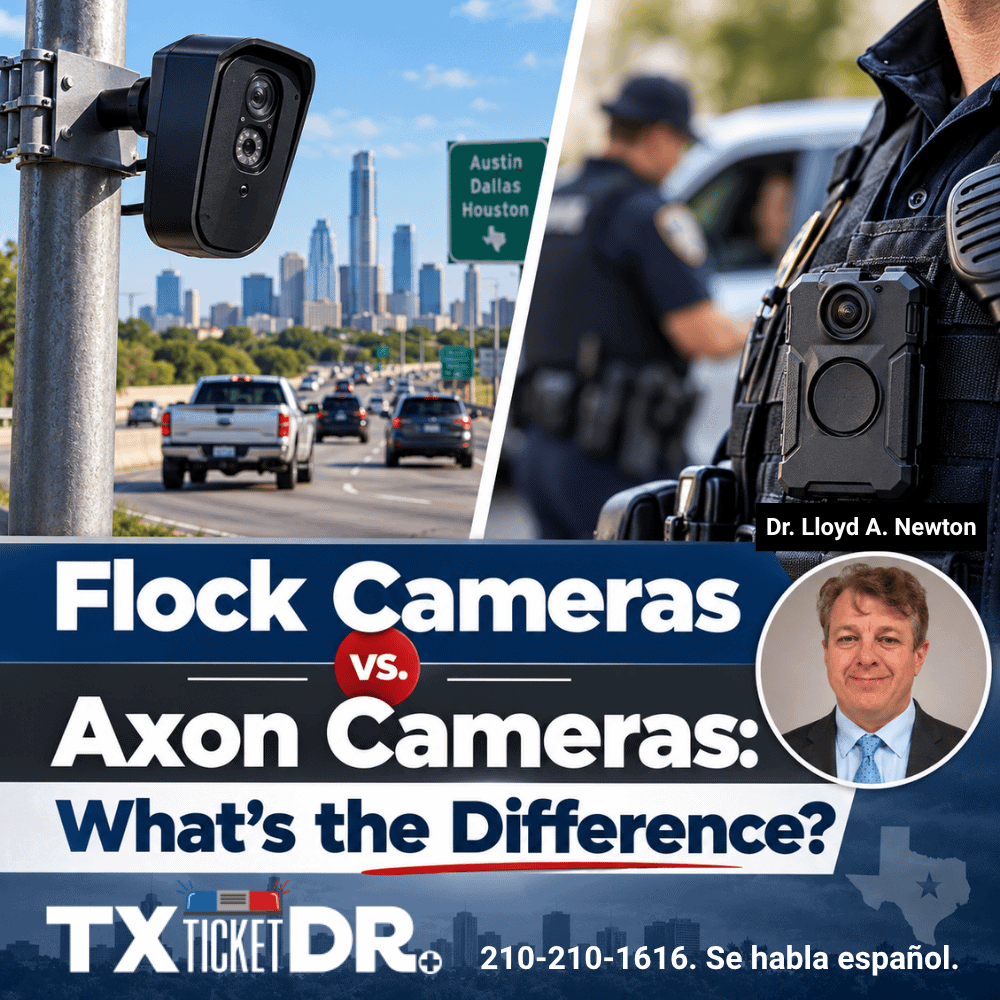
If you drive in Texas, you’ve probably been recorded by a traffic camera without even realizing it. Cameras mounted on poles, attached to police vehicles, and installed along busy roads are becoming increasingly common. Two companies you may hear about are Flock Safety y Axon.
But what is the difference between Flock cameras and Axon cameras? Do they collect the same information? Can police use them to track your vehicle? And could the information they collect be used against you in a traffic ticket or criminal case?
I’m Dr. Lloyd A. Newton, a Texas attorney with Texas Ticket Doctor. As camera technology becomes more common across our state, I believe drivers should understand what these systems do, how law enforcement uses them, and what rights may apply.
The important thing to understand is that Flock and Axon are not simply two brands of the same camera. They offer different technologies, although their products increasingly overlap.
¿Qué son las cámaras Flock Safety?
Flock Safety is a technology company best known for its automated license plate recognition (ALPR) cameras. These cameras are commonly installed along roadways, at neighborhood entrances, near businesses, and in other locations where vehicles pass.
Unlike a traditional security camera that primarily records video for someone to review later, an ALPR camera is designed to identify vehicles and organize information about them.
Depending on the camera and system configuration, Flock technology may capture:
- Placas de matrícula
- Vehicle make and model characteristics
- Color del vehículo
- Distinguishing features, such as roof racks or bumper stickers
- The date and time a vehicle passed a camera
- The camera location where the vehicle was observed
This information can become part of a searchable database.
For example, if a vehicle passes a Flock camera in San Antonio at 9:00 a.m. and another participating camera in Austin later that morning, authorized users may be able to find those observations, depending on system access, data retention, and sharing settings.
That does not mean the cameras continuously follow the vehicle. Instead, they record individual observations at specific locations.
Flock cameras generally do not need to identify the driver to collect useful vehicle information. License plates and vehicle characteristics are often enough to make the information searchable.
Flock also offers video surveillance and other public safety products, so not every Flock camera is an ALPR camera.
What Are Axon Cameras?
Axon is a public safety technology company widely known for its TASER devices and cameras used by law enforcement agencies.
When most people think of Axon cameras, they think of police body cameras. However, Axon offers several camera and evidence management technologies.
These include:
- Body-worn cameras: Cameras worn by police officers that can record interactions, traffic stops, arrests, and other events.
- In-car cameras: Cameras installed in patrol vehicles to record activity during traffic stops and police operations.
- License plate recognition technology: Systems that can help agencies identify and search for vehicles.
- Evidence management software: Digital systems used to store, organize, review, and share recordings and other evidence.
Axon Evidence is an important part of the company’s technology ecosystem. It allows authorized personnel to manage digital evidence collected through supported devices and systems.
For a Texas driver, the most familiar Axon camera may be the body camera worn by an officer who conducts a traffic stop.
That recording could document what happened during the encounter, including conversations, statements, and events relevant to a traffic citation.
However, Axon offers more than body cameras. Its license plate recognition products also compete in the broader vehicle identification market.
Flock Cameras vs. Axon Cameras: Key Differences
Although the companies have overlapping products, their best-known technologies serve different purposes.
| Feature | Flock Safety | Axon |
|---|---|---|
| Best known for | Automated license plate recognition | Police body cameras and TASER devices |
| Common camera locations | Roadside poles, entrances, and other fixed locations | Police uniforms and patrol vehicles |
| Primary traditional use | Identifying vehicles and searching vehicle observations | Recording police encounters and managing evidence |
| License plate recognition | Yes | Yes, through supported ALPR products |
| Vehicle search capabilities | Yes | Yes, depending on the system |
| Video recording | Available through certain products | Core feature of body and in-car cameras |
| Evidence management | Flock software platform | Axon Evidence |
| Data sharing | Depends on agency settings and agreements | Depends on agency settings, products, and agreements |
One distinction matters especially to drivers.
A roadside license plate camera and an officer’s body camera usually collect different types of evidence.
A license plate camera may help establish that a particular vehicle was observed at a specific place and time.
A body camera may help establish what an officer saw, heard, or said during a traffic stop.
Both types of information can be relevant in a legal case, but they don’t prove the same things.
Can Flock and Axon Cameras Track Your Vehicle Across Texas?
This is one of the most important questions I hear when discussing automated license plate recognition.
The short answer is that certain systems can help law enforcement reconstruct portions of a vehicle’s movements by searching observations from multiple cameras.
Imagine that a vehicle travels from Round Rock to Austin and passes several participating license plate recognition cameras.
If those cameras capture the vehicle and an authorized investigator has access to their records, the investigator may be able to determine where and when the vehicle was observed.
This capability raises privacy questions, particularly when observations are collected over time.
However, there are important limitations.
A camera observation does not necessarily establish who was driving. It also does not establish every place the vehicle traveled between observations.
Furthermore, access to information may depend on which agencies operate the cameras, which systems they use, and what data-sharing arrangements are in place.
Not every Flock or Axon camera belongs to one statewide database accessible to every police department.
Who Can Access Information Collected by Flock or Axon?
Camera ownership and data access are not always the same thing.
A police department may operate cameras in its jurisdiction while allowing other agencies to search certain information through approved sharing arrangements.
For example, a department in Central Texas might join a network that lets authorized investigators from other participating agencies search available license plate observations.
The specific access rules depend on the technology, agency policies, contracts, permissions, and applicable law.
Axon’s evidence management systems also allow controlled access and sharing of digital evidence, including recordings that may be relevant to investigations or court proceedings.
As a Texas attorney, I believe an important question is not simply who owns a camera, but who can search the information, why they are searching it, and what records exist of that access.
These questions may matter when camera information becomes part of a legal proceeding.
Can Flock or Axon Camera Evidence Be Used in a Texas Traffic Ticket Case?
Yes, depending on the circumstances.
However, it is important to distinguish between information that helps police investigate an incident and evidence that actually establishes a traffic violation.
Flock Camera Evidence
A license plate recognition camera may show that a vehicle passed a particular location at a particular time.
That information might help identify a vehicle involved in an investigation.
But a license plate observation alone generally does not establish that a driver was speeding, ran a stop sign, or committed another moving violation.
A vehicle’s presence at a location is not the same thing as proof of a traffic offense.
Axon Body Camera and Dash Camera Evidence
Axon body cameras and patrol vehicle cameras may provide a different kind of evidence.
For example, a recording might capture:
- An officer’s interaction with a driver
- Statements made during a traffic stop
- Road conditions or traffic signals
- Events leading up to or following a citation
- Details that support or challenge an officer’s account
Not every camera records continuously, and a recording may not capture the entire event.
When I evaluate a Texas traffic ticket matter, I consider what evidence may exist, whether it is relevant, and what it actually demonstrates.
Video evidence can be useful, but it should not automatically be treated as conclusive.
Are Flock and Axon Cameras Legal in Texas?
Camera systems used by law enforcement are not automatically illegal simply because they collect license plate information or record activity in public places.
However, the legal questions become more complicated when agencies collect, retain, search, and share information.
The Fourth Amendment to the United States Constitution protects people against unreasonable government searches and seizures.
Whether a particular camera-based investigation raises a Fourth Amendment issue depends on the facts, the type of surveillance, and how the information was obtained and used.
Courts have recognized important privacy concerns involving technology that can reveal detailed information about a person’s movements.
For example, the United States Supreme Court’s decision in Carpenter contra Estados Unidos addressed government access to historical cell phone location records.
That decision did not establish that every automated license plate recognition search requires a warrant. ALPR data raises different legal questions, and the circumstances of each case matter.
Texas drivers should also understand that camera-based license plate recognition is different from automated traffic enforcement programs.
For example, Texas law generally prohibits local authorities from operating photographic traffic signal enforcement systems, commonly called red light cameras, under Transportation Code Section 707.020. Certain older contractual obligations have been subject to statutory transition provisions.
That prohibition should not be confused with a general ban on cameras that identify vehicles for investigative purposes.
What Should You Do If Camera Evidence Is Involved in Your Texas Traffic Ticket?
If you receive a Texas traffic ticket and believe camera evidence may be involved, I recommend understanding your options before paying the citation.
Depending on the circumstances, important questions may include:
- What type of camera recorded the incident?
- Did a police department, another government agency, or a private organization operate the camera?
- What information was actually captured?
- Does the evidence identify a vehicle, a driver, or both?
- How was the information obtained and used?
- Are recordings, photographs, or related records available for review?
It is also important to act promptly.
Some camera systems retain information for limited periods. Other evidence may be preserved under different policies or legal requirements.
Waiting too long could make it harder to identify or obtain potentially relevant information.
If you have a court date, don’t ignore it while investigating the evidence. Missing a required appearance could create additional legal problems.
At Texas Ticket Doctor, I help drivers across Texas understand their traffic ticket options and determine what steps may be appropriate for their situations.
Frequently Asked Questions About Flock and Axon Cameras
1. Can Flock cameras give you a speeding ticket in Texas?
Flock’s standard automated license plate recognition cameras are designed primarily to identify vehicles, not automatically issue speeding tickets. A license plate observation alone generally does not establish a speeding violation. Other evidence and circumstances may be relevant.
2. Can police use Axon body camera footage against me in court?
Yes. Relevant body camera footage may be used as evidence in a Texas legal proceeding, subject to applicable rules. However, the recording may also contain information that supports your position or raises questions about the citation.
3. Can I find out whether a Flock camera recorded my license plate?
Possibly. Some camera-related records may be requested through the Texas Public Information Act or other applicable procedures. However, access is not guaranteed. Records may be unavailable, exempt from disclosure, or no longer retained. An attorney can help you understand what information may be obtainable.
Understanding Camera Technology Can Help You Make Better Decisions
Flock and Axon represent two major parts of the expanding public safety technology industry.
Flock is best known for roadside license plate recognition and searchable vehicle observations. Axon is widely associated with police body cameras, patrol vehicle video, and digital evidence management, although it also offers license plate recognition technology.
For Texas drivers, the important issue is not which company manufactured a camera. It is what information was collected, how law enforcement used it, and whether that information matters to a particular legal case.
If you have received a traffic ticket in Texas, do not assume that a camera recording automatically proves the allegation. Likewise, do not assume you can simply disregard camera evidence.
Every case deserves an evaluation based on its actual facts.
Contact me, Dr. Lloyd A. Newton, at Texas Ticket Doctor today for help with your Texas traffic ticket. Call 210-210-1616. Se habla español.
I serve drivers statewide across Texas and can help you understand your options before your court date.
Este artículo es solo para fines informativos generales y no constituye asesoramiento legal. Cada caso es diferente, por lo que debe hablar con un abogado calificado sobre su situación específica.
 (es-419) Español de América Latina
 ¿Qué sucede si un conductor con licencia de conducción de Texas simplemente paga una multa de tráfico?
