

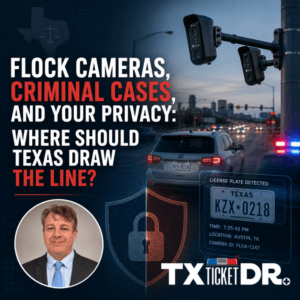
You may have noticed small solar-powered cameras appearing near intersections, neighborhood entrances, shopping centers, and major roads across Texas. Many of these devices are Flock Safety cameras, a type of automated license plate reader used by law enforcement agencies and private communities.
Police departments say these cameras are helping them locate stolen vehicles, identify suspects, recover missing people, and investigate serious crimes. In some cases, Flock camera records have helped connect a particular vehicle to a robbery, shooting, burglary, or other offense.
There is no question that this technology can provide valuable leads. There is also no question that it raises serious concerns about privacy, government surveillance, accuracy, and how digital evidence is used in criminal court.
As a Texas attorney, I believe we need to look carefully at both sides.
What Do Flock Cameras Actually Record?
A Flock camera is not the same as a traditional red light camera. Its primary purpose is not to automatically issue traffic tickets.
These cameras photograph vehicles traveling through a particular location. The system may record information such as:
- The license plate number
- The date and time
- The camera location
- The vehicle’s make, model, and color
- Visible characteristics such as damage, decals, or roof racks
The information becomes searchable by authorized users. An officer investigating a crime may search for a known plate, review vehicles seen near a crime scene, or receive an alert when a plate associated with a stolen vehicle or wanted person passes a camera.
Flock says its license plate reader data is deleted after 30 days by default, although retention settings may depend on the customer and local policies. The company also says its cameras do not use facial recognition and that system access is logged.
The privacy question is not simply whether a camera sees your vehicle in public. The larger question is what happens when thousands of individual sightings are collected, stored, searched, and shared.
How Flock Cameras Are Being Used in Criminal Cases
Flock camera information can become important at several stages of a criminal investigation.
Police may use it to:
- Find a stolen car
- Track the direction a suspect vehicle traveled
- Identify vehicles near a crime scene
- Compare similar crimes in different cities
- Locate a person with an outstanding warrant
- Support an application for a search or arrest warrant
- Challenge or confirm a suspect’s statement about where a vehicle was located
A federal bank robbery case from North Texas shows how significant this evidence can become. Federal prosecutors reported that investigators used a network of Flock license plate readers to connect a man to bank robberies in Dallas and Garland. The defendant was later sentenced to more than 10 years in federal prison. The camera information was part of a larger investigation that also included witness identification and other evidence.
That distinction is important. A Flock camera may generate a lead, but it does not necessarily prove who was driving, who was inside the vehicle, or whether a crime occurred.
A license plate identifies a vehicle. It does not automatically identify the person behind the wheel.
Why Police Support Flock Cameras
I understand why law enforcement agencies find this technology useful.
A victim may only remember part of a license plate. A convenience store camera may capture a blurry image of a fleeing vehicle. A witness may remember that the suspect drove a dark pickup truck but nothing more.
Investigators once had to manually collect footage from businesses, traffic systems, and private cameras. That process could take hours or days. A searchable license plate network may help officers narrow the search much faster.
Houston-area agencies have credited Flock systems with recovering stolen vehicles and assisting in investigations involving theft, burglary, and violent crime. The Houston Police Department has reportedly recovered more than $7.4 million in stolen vehicles since it began using the system in 2021.
Conroe police have also reported that Flock information played a role in dozens of arrests involving outstanding warrants.
When police are searching for an armed suspect, an abducted child, or a stolen vehicle, time matters. A fast and accurate alert may protect officers, victims, and the public.
Why Flock Evidence Must Be Examined Carefully
Useful technology is not automatically reliable evidence.
License plates may be misread. A plate may be stolen, duplicated, obscured, or attached to a different vehicle. A vehicle owner may have loaned the car to someone else. The system may identify a similar vehicle that has no connection to the alleged crime.
Some Texas agencies recognize this risk. Bexar County’s published policy states that scanned license plates must be verified by law enforcement personnel and checked through Texas criminal information systems before officers take enforcement action.
In a criminal case, attorneys may need to examine questions such as:
- Was the plate read correctly?
- Was the alert confirmed before the traffic stop?
- Who searched the system, and why?
- Was the search connected to a legitimate investigation?
- Were the time and location records accurate?
- Was the information shared with another agency?
- Can prosecutors prove who was driving?
- Was other evidence found because of the Flock alert?
A camera record should not be treated as unquestionable simply because it was generated by a computer.
Can Police Search Flock Records Without a Warrant?
This is one of the biggest unresolved legal questions surrounding automated license plate readers.
Courts have often held that drivers have a limited expectation of privacy in a license plate displayed on a public road. However, privacy advocates argue that a large network of cameras can reveal far more than a single officer observing one car at one intersection.
A searchable history might reveal repeated visits to a church, political meeting, medical office, attorney’s office, support group, or another sensitive location.
Recent courts have not reached one universal conclusion. A Virginia appellate court ruled in 2025 that the license plate reader system at issue did not require a warrant. In January 2026, a federal judge also ruled that Norfolk’s use of Flock cameras did not violate the Fourth Amendment. Other lawsuits and legal challenges continue to argue that broad, long-term tracking should be treated as a search requiring greater constitutional protection.
Texas courts may eventually need to decide where observation ends, and continuous digital tracking begins.
The Risk of Misuse Is Not Theoretical
The strongest privacy concerns are not only about what technology can do. They are also about what individual users may do with it.
In Pasadena, Texas, a police sergeant resigned during an internal investigation after allegations that he misused the department’s Flock system to monitor and track a female officer. The allegations show why access controls, audit records, supervision, and meaningful penalties matter.
A system designed to investigate crime should not become a tool for personal surveillance, harassment, political monitoring, or curiosity searches.
Flock says customers control data sharing and that searches are subject to access controls and audit logs. Those protections are valuable only when agencies regularly review the logs and respond when policies are violated.
Where Should Texas Draw the Line?
I do not believe the only choices are unlimited surveillance or no technology at all.
Texas can allow police to use effective investigative tools while creating firm protections for innocent drivers. Reasonable safeguards could include:
- Requiring a documented criminal justice purpose for every search
- Limiting how long routine vehicle records are stored
- Requiring officers to verify alerts before stopping a vehicle
- Restricting searches involving political, religious, medical, or other protected activities
- Limiting access by outside agencies
- Conducting regular audits for misuse
- Requiring clear public policies and transparency reports
- Preserving records needed by defendants to challenge the evidence
The public should know how these systems are used. Defendants should also have a fair opportunity to examine camera records, search histories, audit logs, and other information when Flock evidence contributed to a stop, search, arrest, or prosecution.
Technology can help solve crimes. It should not be allowed to bypass constitutional rights.
Frequently Asked Questions About Flock Cameras and Criminal Cases
Can a Flock camera prove that I committed a crime?
Not by itself. A Flock record may show that a vehicle or license plate was photographed at a particular place and time. It does not necessarily prove who was driving or what that person was doing. Prosecutors usually need additional evidence to connect an individual to the alleged crime.
Can a Flock alert give police a reason to stop my vehicle?
A confirmed alert involving a stolen vehicle, stolen plate, wanted person, or active investigation may contribute to an officer’s decision to make a stop. Whether the stop was lawful depends on the source, accuracy, verification, and specific circumstances.
Can Flock camera evidence be challenged in court?
Yes. Depending on the case, an attorney may examine the accuracy of the plate reading, how the system was searched, whether officers verified the alert, how the evidence was preserved, and whether the stop or search complied with the law.
Flock Evidence Can Change a Criminal Case
Flock cameras are giving law enforcement a powerful new way to investigate crimes across Texas. They may help find dangerous suspects and recover stolen property, but they also create detailed records of where ordinary people travel.
When this technology contributes to a traffic stop, arrest, warrant, or criminal charge, the details matter. The camera record should be reviewed alongside the officer’s actions, system logs, search history, and all other available evidence.
Before making decisions that could affect your freedom, license, or future, speak with an attorney who can review your specific circumstances.
Contact Dr. Lloyd A. Newton, Texas Ticket Doctor, today for help with your Texas traffic ticket or related case. Call 210-210-1616. Se habla español.
This article is for general information only and is not legal advice. Every case is different, so speak with a qualified attorney about your specific situation.

 When should I Pay a Ticket vs Take a Driver Safety Course?