

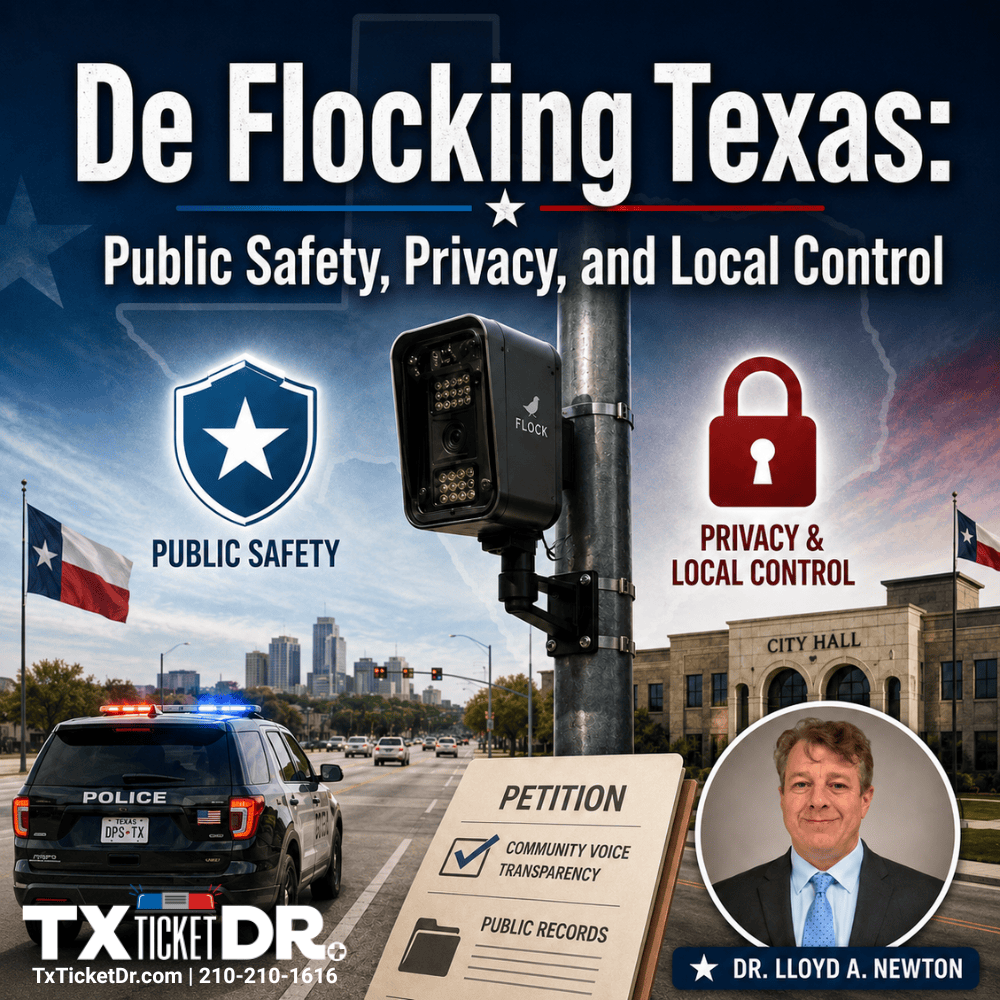
Flock Safety cameras are appearing along roads, at intersections, near neighborhoods, and around commercial areas across Texas. These automated license plate readers photograph passing vehicles and record information such as the license plate, vehicle type, location, and time.
Supporters say the cameras help law enforcement locate stolen vehicles, identify suspects, find missing people, and investigate serious crimes. Critics worry that a system built for public safety can also create a searchable record of where ordinary people travel.
That disagreement has led to a growing movement sometimes called “de-flocking.” In most communities, de-flocking does not mean physically removing or damaging cameras. It means using public records, petitions, public meetings, elections, and local government procedures to persuade officials to end a Flock Safety contract or place stronger limits on the technology.
Texas communities are now asking an important question: How much surveillance should local government accept in the name of public safety?
What Are Flock Safety Cameras?
Flock Safety cameras are a type of automated license plate reader, often called an ALPR. They capture images of vehicles traveling through the camera’s field of view.
Depending on the system and its settings, the technology may record:
- License plate numbers
- Vehicle make, model, and color
- Distinguishing vehicle features
- The location of the camera
- The date and time the vehicle passed
Participating law enforcement agencies can search the system during an investigation. Agencies may also share access with other departments, depending on their policies, agreements, and account settings.
Flock Safety presents its technology as a tool that helps investigators quickly turn vehicle information into useful evidence. The company also says its products are designed with privacy protections and do not use facial recognition to identify drivers or passengers.
The concern for many residents is not simply what one camera sees. It is what can happen when hundreds or thousands of cameras become part of a broad, searchable network.
Why Some Texas Residents Want to “De-Flock” Their Communities
People who oppose Flock cameras often point to questions about data access, retention, sharing, oversight, and possible misuse.
A license plate is attached to a vehicle, but that vehicle is usually connected to a person. Repeated camera sightings could reveal trips to medical offices, religious services, political events, businesses, homes, or other sensitive locations.
Critics also worry about what is sometimes called mission creep. A system purchased for stolen vehicle investigations may eventually be used for broader purposes that were never fully discussed when the original contract was approved.
These concerns became part of Austin’s debate over its automated license plate reader pilot program. A city audit found that Austin’s agreement could potentially allow Flock Safety to retain data that might later be used by other law enforcement entities, despite Austin’s policy of limiting access to city employees.
Public safety advocates respond that these cameras can provide valuable leads in cases where officers have limited information and little time. They argue that removing a useful investigative tool could make it harder to locate suspects, recover stolen vehicles, or respond to dangerous situations.
Both concerns deserve an honest discussion. Public safety matters, but so do privacy, accountability, and clear limits on government power.
How Austin Residents Helped End the City’s Flock Program
Austin provides one of the clearest Texas examples of lawful community action affecting a Flock camera program.
Residents and advocacy organizations studied the contract, reviewed the city audit, contacted council members, spoke during public meetings, and urged the Austin City Council not to continue the program. Community participation helped turn a technology contract into a broader public debate about surveillance and civil liberties.
The city’s pilot was scheduled to terminate in June 2025 unless the City Council authorized its continuation. Organizers opposed extending it, and Austin ultimately allowed the Flock program to end.
This is an important example because residents did not need to damage equipment or interfere with police operations. They used the city’s own public process.
How San Marcos Reconsidered Its Flock Cameras
San Marcos also reconsidered its use of automated license plate readers after residents and council members raised privacy and policy concerns.
In June 2025, the San Marcos City Council voted 5 to 2 against spending approximately $124,000 to expand the city’s Flock equipment and software.
The police department later made several changes, including stopping automatic sharing of license plate reader data with other law enforcement agencies. In December 2025, the City Council directed staff to discontinue the Flock Safety contract and investigate other camera options.
San Marcos shows that de-flocking does not always begin with an immediate demand to remove every camera. Citizens may first ask officials to stop an expansion, limit data sharing, strengthen policies, review the contract, and require a new public vote before renewal.
Lawful Methods Citizens Use to De-Flock a City
Residents who are concerned about Flock cameras have several lawful ways to participate.
Submit Texas Public Information Act Requests
The Texas Public Information Act allows people to request records collected, assembled, or maintained by or for a governmental body.
A request may seek records such as:
- The city or county’s Flock Safety contract
- Purchase orders and invoices
- Camera policies and operating procedures
- Data retention rules
- Lists of agencies receiving shared access
- Audit logs and search statistics
- Training materials
- Emails discussing the program
- Council presentations and staff recommendations
- Records showing how often camera information produced investigative leads
Some information may be withheld or redacted under Texas law, especially records involving active investigations, security details, or protected motor vehicle information. A public records request can still help residents understand the cost, scope, rules, and oversight surrounding a program.
Attend City Council or Commissioners Court Meetings
Local officials usually approve the contracts and funding that make camera programs possible.
Residents can monitor agendas for items involving:
- Flock Safety
- Automated license plate readers
- Police technology
- Surveillance equipment
- Public safety grants
- Contract renewals
- Camera expansions
Speaking during public comment gives residents an opportunity to ask specific questions and place their concerns in the official record.
General statements about privacy may be helpful, but focused questions are often more effective:
- Who can search the data?
- How long is the information retained?
- Which outside agencies have access?
- Are searches audited?
- What happens when an employee misuses the system?
- Can federal agencies obtain the data?
- How many investigations produced arrests or other measurable results?
- What is the total annual cost?
- Does the contract automatically renew?
Organize a Petition
Petitions can show elected officials that concern extends beyond a small group of meeting attendees.
In Conroe, opposition grew after a resident filed an open records request and helped organize a petition that reportedly gathered more than 1,200 signatures. The campaign pushed city leaders to debate additional review and the possibility of placing the issue before voters.
A Tyler-area petition launched in 2026 similarly sought to bring concerns about Flock cameras before the Smith County Commissioners Court.
A strong petition should clearly state what residents are requesting. That might include ending the contract, placing renewal on a public agenda, conducting an independent audit, limiting data sharing, or adopting a surveillance technology ordinance.
Contact Elected Officials Individually
Public meetings are important, but direct communication can also influence the process.
Residents may contact:
- City council members
- The mayor
- County commissioners
- The county judge
- Police oversight boards
- City managers
- County administrators
- State representatives
Messages are more persuasive when they identify a specific decision and request a specific action. For example, a resident could ask an official to vote against an upcoming renewal unless the city adopts stronger retention, auditing, and data-sharing limits.
Ask for an Independent Audit
An audit can compare promises made to the public with the way a system actually operates.
A meaningful audit may review:
- Who searched the database
- Why each search was conducted
- Whether searches were connected to legitimate investigations
- Which agencies accessed local data
- Whether information was retained beyond the approved period
- Whether officers followed written policies
- Whether the program produced measurable public safety benefits
Regular audits can also help communities identify misuse without assuming that every officer or every search was improper.
Push for a Surveillance Technology Ordinance
Some residents do not necessarily want to prohibit all police technology. They want elected officials to create rules before new systems are purchased.
A local ordinance could require:
- Public notice before acquisition
- A written use policy
- City council approval
- Limits on data retention
- Restrictions on outside sharing
- Search logs and annual reports
- Independent audits
- Penalties for misuse
- A new public vote before contract renewal
This approach gives local officials a way to balance investigative needs with public accountability.
Support Candidates and Ballot Measures
Local elections determine who approves police technology contracts and who establishes oversight policies.
Residents may ask candidates where they stand on automated license plate readers, data sharing, warrants, audits, and vendor contracts. In some circumstances, citizens may also pursue a local ballot measure, subject to the city charter and applicable election laws.
Damaging Cameras Is Not Lawful Civic Action
Some people have cut down, covered, painted, or otherwise damaged Flock cameras. Recent incidents in Houston included cameras being cut from their poles amid the larger privacy debate.
Damaging equipment is not the same as participating in the democratic process. Depending on the circumstances, it may result in criminal charges, civil liability, restitution, or other consequences. It may also weaken the broader privacy argument by shifting public attention away from policy concerns and toward vandalism.
People should not cut wires, block lenses, climb poles, interfere with equipment, trespass, or attempt to access a camera system.
Citizens can strongly oppose surveillance without destroying property. Open records requests, public comments, petitions, audits, elections, and organized advocacy have already influenced real decisions in Texas.
Public Safety and Privacy Do Not Have to Be Enemies
The debate over Flock cameras is often presented as a choice between supporting police and supporting privacy. That is too simple.
A person can support effective law enforcement while still asking who has access to sensitive information. A police department can value investigative technology while accepting limits, audits, and public oversight.
Local control gives Texas communities an opportunity to decide what balance is right for them. Some cities may discontinue Flock contracts. Others may keep the cameras but adopt stricter rules. Still others may seek different technologies with more local control over storage and sharing.
The important point is that these decisions should not happen quietly. Residents deserve to know what technology is being used, what information it collects, how much it costs, who can access it, and what safeguards exist.
Frequently Asked Questions About De-Flocking Texas
Is it legal to remove or cover a Flock camera?
Citizens should not physically remove, cover, disable, or damage a camera they do not own. Doing so may lead to criminal charges or civil liability. Concerns should be addressed through public records requests, elected officials, public meetings, petitions, and other lawful processes.
Can Texas residents request records about Flock cameras?
Yes. The Texas Public Information Act allows people to request many records held by a city, county, police department, or other governmental body. Some information may be withheld or redacted because of privacy, security, or law enforcement exceptions.
Can a city council end a Flock Safety contract?
Depending on the contract terms and local procedures, a city council may vote against renewal, deny an expansion, direct staff to terminate an agreement, or adopt restrictions on future use. Every contract and governmental process is different.
Local Decisions Can Have Lasting Consequences
Flock cameras may help investigate crimes, but they also create serious questions about privacy, data access, oversight, and government accountability.
Texans who are concerned about these systems have lawful options. They can investigate the program, request records, speak at meetings, organize neighbors, petition elected officials, demand audits, and vote.
The strongest form of de-flocking is not secretive or destructive. It is informed, organized, peaceful, and public.
Questions about surveillance technology can also overlap with criminal investigations, traffic stops, warrants, and other legal matters. Contact Dr. Lloyd A. Newton, Texas Ticket Doctor, today for help with your Texas traffic ticket. Call 210-210-1616. Se habla español.
This article is for general information only and is not legal advice. Every case is different, so speak with a qualified attorney about your specific situation.

 Flock Cameras, Criminal Cases, and Your Privacy: Where Should Texas Draw the Line?