

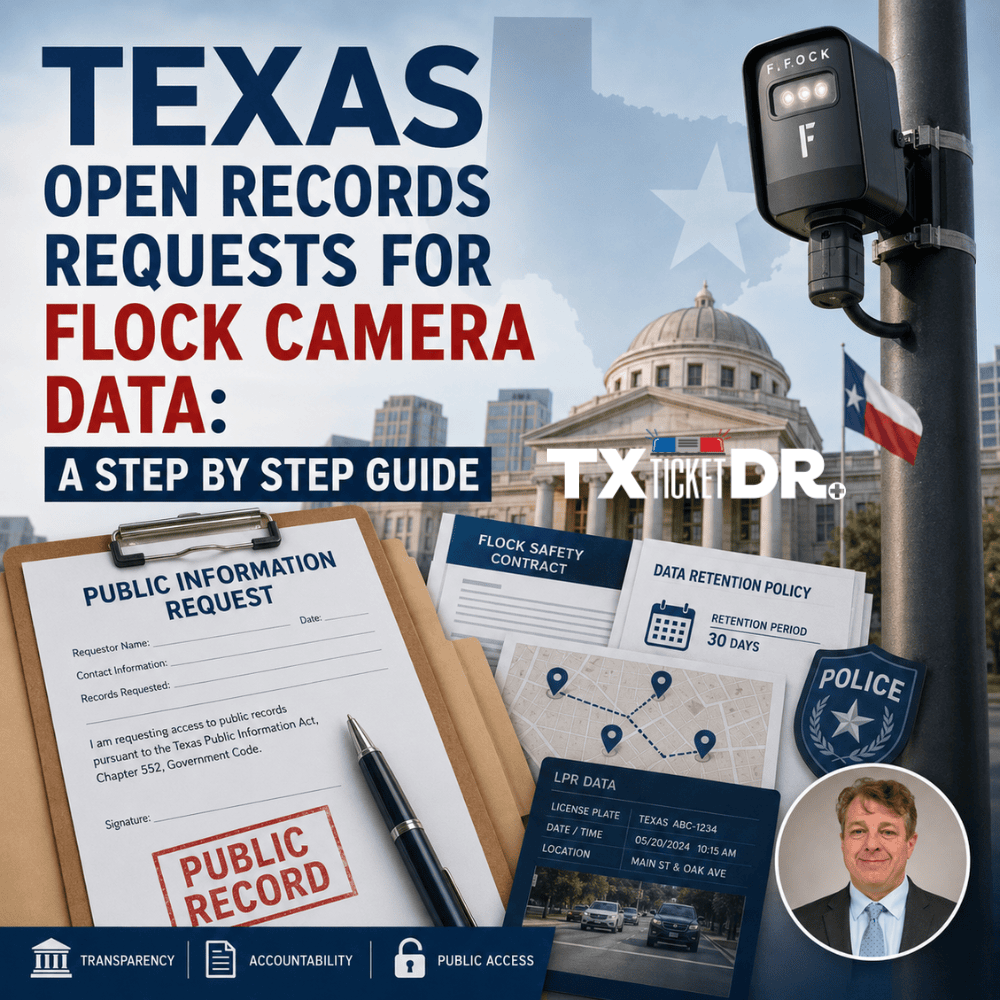
Flock Safety cameras are appearing in more Texas communities. These automated license plate reader systems capture information about passing vehicles and may alert law enforcement when a plate matches a designated list.
Supporters believe the technology can help police investigate stolen vehicles and serious crimes. Critics worry about surveillance, data retention, information sharing, and the ability of government agencies to track ordinary drivers.
Whatever your position may be, you have the right to ask questions about how your local government uses this technology.
In Texas, requests for records from cities, counties, police departments, and other state or local governmental bodies are generally made under the Texas Public Information Act, not the federal Freedom of Information Act. FOIA generally applies to records held by federal agencies.
Here is a practical guide to requesting Flock camera information legally and effectively.
Step 1: Decide What Flock Camera Records You Want
Before submitting a request, identify the records you are actually seeking.
A public information request is designed to obtain records that already exist. The governmental body generally does not have to answer questions, conduct research, provide an explanation, or create a new report for you.
Instead of asking:
“Why did the city install Flock cameras?”
Ask for records such as:
- Contracts between the city and Flock Safety
- Purchase orders, invoices, and payment records
- Policies governing camera use
- Data retention policies
- Camera location lists or maps
- Agreements allowing other agencies to access the system
- Records describing who can search the database
- Training materials provided to officers
- Audit logs showing system access
- Statistical reports about alerts or investigations
- Emails between city officials and Flock Safety
- City council agendas, presentations, and meeting materials
- Records discussing privacy, cybersecurity, or misuse concerns
- Policies for adding license plates to alert or hot lists
- Records explaining how inaccurate alerts are handled
You may submit separate requests for different categories. A focused request is often easier for the agency to understand and may reduce delays and costs.
Why Public Information Requests Matter
Public information requests give Texans a lawful way to examine how government decisions are made. They can reveal contracts, spending, internal discussions, policies, and other details that may not otherwise receive public attention.
Dr. Lloyd A. Newton has seen the process from the government’s side while working with a law firm that handled public information requests. In his experience, responding to these requests can require significant time and effort from a city or governmental agency.
That work serves an important purpose. A well-written request can bring greater transparency to decisions involving public money, surveillance technology, law enforcement policies, and government accountability. It may also help uncover inconsistencies, questionable practices, or information that deserves closer public scrutiny.
The goal should not be to overwhelm public employees. The goal should be to obtain meaningful records that help residents understand what their government is doing.
Step 2: Identify the Governmental Body That Has the Records
Send your request to the Texas governmental body that is most likely to maintain the information.
Depending on the records you want, that may be:
- The city clerk
- The police department
- The county sheriff’s office
- The city purchasing department
- The city manager’s office
- The city attorney’s office
- A regional law enforcement organization
A request sent only to Flock Safety may not be a Texas Public Information Act request because Flock Safety is a private company. However, contracts, correspondence, reports, and other Flock-related records maintained by a Texas governmental body may be subject to the Act, depending on the nature of the records and applicable exceptions.
Check the city or police department website for a page labeled “Open Records,” “Public Information,” or “Public Information Act Requests.” Many agencies use an online request portal or provide a designated email address.
Step 3: Send the Request Through an Approved Method
A Texas public information request must be in writing and delivered to the governmental body’s public information officer or designated representative.
Approved delivery methods generally include:
- United States mail
- Hand delivery
- Another method approved by the governmental body, such as an online portal
Texas governmental bodies may designate specific mailing and email addresses for public information requests. Using the address or portal listed on the agency’s website helps ensure the request is officially received.
Keep a copy of your request and proof that it was delivered. Save confirmation emails, portal receipt numbers, certified mail records, or screenshots.
Step 4: Clearly Describe the Records and Date Range
Use Smaller, Focused Requests
Cities sometimes provide large cost estimates when a request covers thousands of pages, many employees, or several years of records. Broad requests may also lead to clarification questions, delays, and extensive redactions.
Dr. Newton recommends breaking a large research project into smaller, clearly defined requests. For example, instead of requesting every record related to Flock cameras, begin with one category:
- The current Flock Safety contract
- The current data retention policy
- The list of agencies with shared access
- Emails involving specific officials during a limited date range
- Audit logs for a specific month
- City council presentations related to the original purchase
A focused request is easier for the governmental body to understand and easier for the requester to evaluate. It also leaves less uncertainty about which records are being sought.
However, do not divide one request into several submissions merely to evade lawful charges. A Texas governmental body may combine separate requests received from the same person within one calendar day when calculating costs.
A better strategy is to work in logical stages. Review the contract first. That document may identify the department, dates, policies, and officials involved. You can then use those details to prepare a more precise follow-up request.
Sample Texas Public Information Act Request
To the Public Information Officer:
Under the Texas Public Information Act, Chapter 552 of the Texas Government Code, I request electronic copies of the following existing records:
- All current contracts, amendments, purchase orders, and invoices between the City of [City Name] and Flock Safety.
- All policies, procedures, directives, or training materials governing the city’s use of Flock Safety cameras or automated license plate reader technology.
- Any current records describing data retention periods, user access, audit procedures, information sharing with outside agencies, and the process for adding license plates to alert lists.
- Any current list or map identifying the general locations of Flock Safety cameras operated for or accessible to the city.
This request covers records created or maintained between [Starting Date] and [Ending Date].
Please provide the records electronically by email or downloadable link. If the estimated cost will exceed $[Amount], please provide a written cost estimate before processing the request.
If any information is withheld or redacted, please identify the legal authority relied upon for the withholding or redaction.
Thank you.
[Name]
[Email Address]
[Telephone Number, optional]
You do not have to use these exact words. The most important part is clearly identifying the records you want.
Step 5: Be Prepared for Clarification or a Cost Estimate
A governmental body may ask you to clarify an unclear request. It may also ask whether you are willing to narrow a request that covers a large amount of information.
The agency generally may not ask why you want the records, although it may request information needed to clarify the search or determine whether certain protected motor vehicle information can legally be released. A request may be treated as withdrawn if the requester fails to respond to a proper written clarification request within the period allowed by law.
The agency may also charge authorized costs for locating, reviewing, copying, programming, or producing records. Asking for electronic records, limiting the date range, and requesting a cost estimate before work begins may help you control expenses. The Texas Attorney General’s Open Records Division oversees rules concerning charges and receives complaints involving possible overcharges.
Step 6: Understand the Ten Business Day Rule
The Texas Public Information Act requires governmental bodies to respond promptly.
The commonly discussed ten-business-day period does not always mean you will receive every record within ten business days. Generally, within that period, the governmental body must take an appropriate action, such as:
- Release the information
- Tell you when it will be available
- State that no responsive records were found
- Request a ruling from the Texas Attorney General to withhold information
- Notify you that information is being withheld under an applicable previous determination
Large or complicated requests may take longer to produce.
Step 7: Expect Some Flock Camera Information to Be Redacted
Not every Flock-related record will necessarily be released in full.
Texas law protects certain categories of confidential information. Common examples include driver’s license numbers, license plate numbers, dates of birth, juvenile records, and some information connected to law enforcement investigations.
A police department may also argue that releasing certain camera locations, investigative searches, active alerts, hot-list information, access credentials, cybersecurity details, or records connected to a pending case could interfere with law enforcement or expose confidential information.
That does not necessarily mean the entire request can be denied. An agency may release public portions of a document while withholding or redacting protected material when permitted by law.
Step 8: Review the Response Carefully
When records arrive, compare them with your original request.
Look for:
- Missing date ranges
- Missing attachments
- References to documents that were not included
- Unexplained redactions
- Statements that no responsive records exist
- Notices that an Attorney General ruling has been requested
If emails refer to an attached policy, presentation, map, or contract that was not provided, submit a polite follow-up request identifying that specific record.
Organize everything by date and record type. This can help you understand when the cameras were approved, what officials were told, how much the system costs, how long data is kept, and which agencies may access it.
Step 9: Know Where to Ask for Help
If you believe a Texas governmental body has not properly handled your request, the Texas Attorney General provides an Open Government Hotline.
The current numbers listed by the Attorney General are:
- 512-478-6736
- Toll free: 877-673-6839
The Attorney General also accepts certain complaints involving Public Information Act compliance and charges.
Texas Public Information Act Versus Federal FOIA
People often use “FOIA request” as a general term for any government records request. Legally, however, the distinction matters.
The federal Freedom of Information Act applies to federal executive branch agencies. It generally does not control requests sent to Texas cities, municipal police departments, county sheriff’s offices, or Texas state agencies. Requests to those governmental bodies are usually governed by the Texas Public Information Act.
Using the correct law and sending the request to the correct office can help prevent unnecessary confusion.
Frequently Asked Questions About Texas Flock Camera Records
Can I request a list of Flock camera locations in Texas?
You may request existing maps, spreadsheets, contracts, or other records identifying camera locations from the governmental body that maintains them. The agency may release the records, redact portions, or argue that an exception applies, depending on the information and circumstances.
Can I request every license plate captured by a Flock camera?
You may submit the request, but broad requests for individual vehicle records may raise privacy, motor vehicle record, law enforcement, and cost concerns. License plate numbers and other identifying information may be withheld or redacted. A request for policies, aggregate statistics, audit reports, or retention rules may provide useful information with fewer privacy concerns.
Does a city have to answer why it purchased Flock cameras?
The Public Information Act generally requires agencies to provide existing records, not answer questions or create explanations. Instead of asking why the cameras were purchased, request council presentations, emails, staff reports, contracts, meeting minutes, and other records discussing the decision.
Public Records Can Help Texans Participate Responsibly
You do not have to damage equipment, interfere with police operations, or trespass near a camera to learn more about your community’s surveillance practices.
Public information requests offer a lawful way to examine contracts, spending, policies, data retention, information sharing, and government oversight. The records can help residents prepare informed questions for city officials, participate in public meetings, and discuss the balance between public safety and personal privacy.
When a Flock camera alert becomes part of a traffic stop, arrest, warrant, or criminal investigation, the legal issues become more complicated. Public records requests are not a substitute for discovery in a criminal case or advice from an attorney who understands the facts.
Contact Dr. Lloyd A. Newton, Texas Ticket Doctor, today for help with your Texas traffic ticket or related court matter. Call 210-210-1616. Se habla español.
This article is for general information only and is not legal advice. Every case is different, so speak with a qualified attorney about your specific situation.

 De Flocking Texas: Public Safety, Privacy, and Local Control