

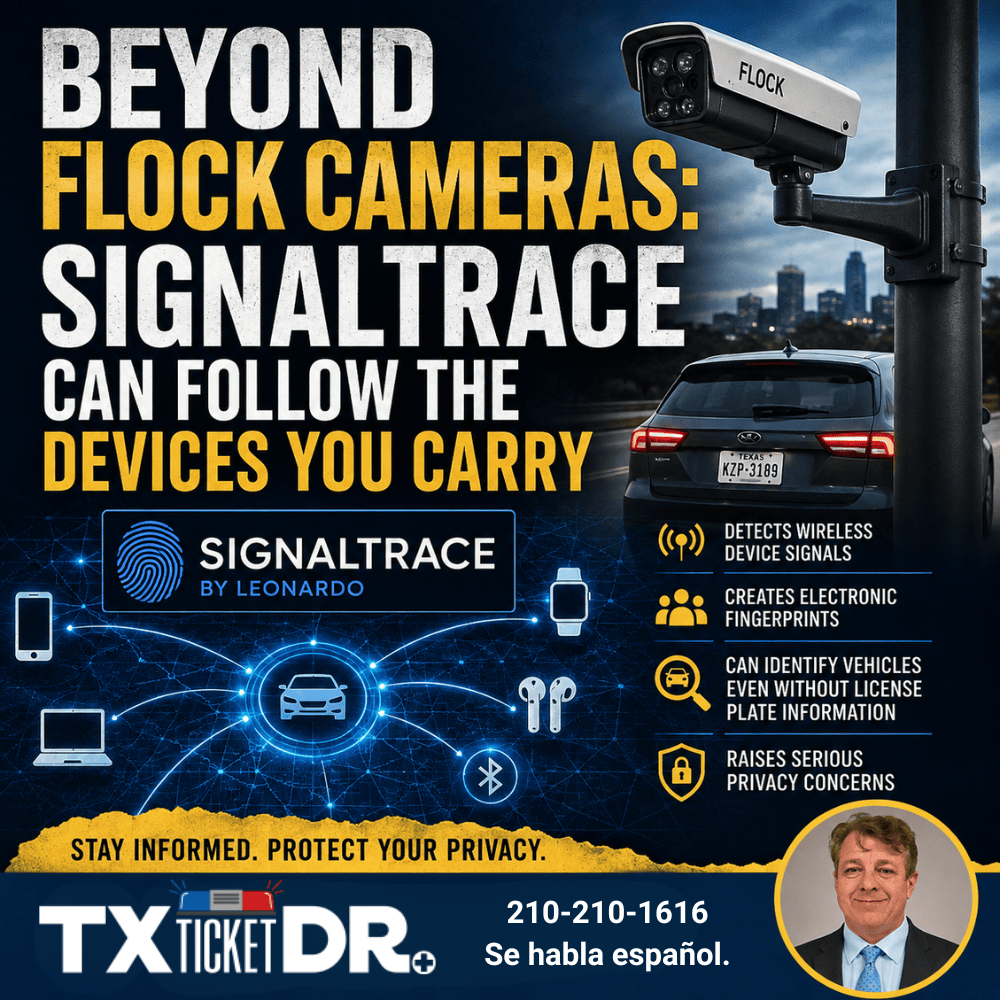
If you have been following my recent articles about Flock Cameras, you already know why automated license plate readers have created such a heated debate across Texas.
These cameras can photograph vehicles, identify license plates, record locations, and create searchable records that law enforcement can use during investigations. Supporters see an effective crime-fighting tool. Critics see the foundation of a surveillance network capable of documenting where ordinary people travel.
Now, I want to tell you about a technology that takes that conversation to the next level.
It is called SignalTrace, and instead of focusing only on the license plate attached to your vehicle, this technology can potentially recognize the electronic devices you are traveling with.
Your phone. Your smartwatch. Your wireless headphones. Your vehicle’s electronics. Other devices transmitting wireless signals.
That creates an important question we need to start asking:
What happens when surveillance technology no longer needs your license plate to recognize that you have passed by?
What Is SignalTrace?
First, I want to clear up an important distinction.
SignalTrace is not a Flock Safety product.
It is an electronic signal intelligence system developed by Leonardo and marketed as ELSAG SignalTrace. Leonardo also produces automated license plate recognition technology used by law enforcement. I am discussing SignalTrace alongside Flock Cameras because both technologies are part of the larger conversation about automated vehicle surveillance.
According to Leonardo, SignalTrace is designed to identify electronic devices that may be associated with people or vehicles. The company says the technology can recognize groups of consumer electronic devices that routinely travel together, even when investigators do not know a license plate number.
That is a significant expansion of what most people think about when they hear the words “license plate reader.”
How Does SignalTrace Track Your Electronic Devices?
Think about everything transmitting or receiving wireless signals while you drive.
You might have:
- A smartphone
- A smartwatch
- Bluetooth headphones
- A fitness tracker
- A vehicle infotainment system
- A wireless hotspot
- A laptop or tablet
- RFID-enabled devices
Leonardo says SignalTrace can detect publicly broadcast frequency activity from smartphones, Bluetooth wearables, vehicle electronics, and other devices. It can then correlate devices that appear near one another and potentially connect those observations with license plate reader data.
Recent reporting on the technology describes SignalTrace as collecting information from Bluetooth and other wireless devices and associating those devices with vehicles.
This does not mean the system is necessarily opening your phone, reading your text messages, or listening to your conversations.
The concern is different.
The system can potentially recognize electronic signals associated with devices that repeatedly travel together.
SignalTrace Can Create an Electronic Fingerprint
This is where SignalTrace becomes especially interesting to me.
Leonardo describes the technology as creating an electronic fingerprint based on the combination of devices located around a vehicle.
Imagine that every morning you leave home with the same combination of devices.
Your phone is with you.
Your smartwatch is on your wrist.
Your Bluetooth headphones are in the console.
Your vehicle’s wireless systems are operating.
Each individual signal may not tell someone exactly who you are. But when the same group of electronic devices repeatedly appears together, that combination can become much more distinctive.
SignalTrace is designed to identify groups of devices that routinely travel together and use that information as another investigative lead. Leonardo specifically promotes the ability to identify vehicles or people even when a license plate number is unknown.
In practical terms, the license plate may no longer be the only identifying characteristic attached to a vehicle.
The collection of electronics traveling inside it could become another identifier.
Flock Cameras Track Cars. SignalTrace Goes Further.
This is why I think Texans who are concerned about Flock Cameras should also understand SignalTrace.
Traditional automated license plate readers are built around a fairly simple concept.
A vehicle passes a camera. The system photographs or identifies the license plate and records information associated with that observation.
SignalTrace introduces another layer.
Instead of asking only:
Which license plate passed this location?
Investigators may eventually be able to ask:
Which collection of electronic devices passed this location?
That matters because license plates can change.
People drive different cars.
Family members borrow vehicles.
Rental cars are common.
But people tend to carry the same phones, watches, headphones, and other personal electronics with them throughout the day.
That possibility changes the privacy discussion considerably.
Why Would Police Want SignalTrace?
There are legitimate law enforcement arguments for this technology, and I do not think we should ignore them.
Leonardo markets SignalTrace as a way to develop investigative leads involving suspects and vehicles. The company has also described applications involving organized retail crime, where investigators may try to determine whether the same people, vehicles, or devices repeatedly appear during related crimes.
A technology capable of connecting a suspect vehicle with devices repeatedly associated with it could potentially help investigators identify patterns they might otherwise miss.
That is the public safety argument.
And just as I have said in my discussions about Flock Cameras, the fact that technology can be useful does not automatically answer the question of how broadly it should be used.
The Privacy Question Is Bigger Than One Camera
What concerns me most about technologies like SignalTrace is not one sensor sitting beside one road.
It is what happens when information from many sensors can be collected, stored, searched, and correlated.
One observation may tell investigators very little.
Repeated observations can tell a very different story.
They may begin to show where a person travels, which vehicle they regularly occupy, which devices travel with them, and potentially which groups of devices repeatedly appear together.
The United States Supreme Court has already recognized that digital location information can raise serious Fourth Amendment concerns. In Carpenter v. United States, the Court held that the government’s acquisition of historical cell-site location records constituted a Fourth Amendment search, emphasizing the privacy implications of detailed records of a person’s movements.
That does not automatically mean SignalTrace is unconstitutional.
It does mean courts will likely have difficult questions to address as surveillance technology becomes capable of creating increasingly detailed pictures of people’s movements.
Every situation will depend on the technology being used, what information is collected, how long it is retained, how investigators access it, and the particular facts of a case.
Texas Is Already Debating Automated Surveillance
This is not an abstract issue for Texas.
Automated license plate reader programs have already produced significant debates over privacy, data sharing, oversight, and government surveillance.
Austin ended its police license plate reader program in 2025 after concerns about privacy and how information was being used, although Texas DPS subsequently installed automated license plate readers within state rights-of-way in Austin.
The debate remains active in 2026. Communities around Texas continue to discuss whether Flock Cameras and similar systems should be expanded, restricted, or removed. Recent debates in Houston-area cities have even included proposals to let voters weigh in on whether local governments should continue using the technology.
Leonardo also offers its ELSAG license plate recognition products to Texas agencies through state procurement channels. However, as of the publication of this article, I have not found reliable documentation establishing that a particular Texas police department is currently operating SignalTrace itself.
That distinction matters.
I don’t want to frighten people by suggesting that technology is already deployed somewhere when the evidence does not establish that.
But I do believe Texans should know the technology exists before it quietly becomes another normal part of the surveillance landscape.
The Time to Ask Questions Is Before SignalTrace Arrives
One lesson from the Flock Camera debate should be obvious by now.
The worst time for citizens to begin asking questions about surveillance technology is after a large network has already been installed.
If your city or police department considers technology such as SignalTrace, I believe residents should ask some very basic questions:
- What information does the system collect?
- Does it detect Bluetooth, Wi-Fi, RFID, or other wireless signals?
- How long is that information retained?
- Can device information be connected to license plate records?
- Qui peut rechercher les données ?
- Can outside agencies access it?
- Is a warrant required for certain searches?
- Is information about people who are not suspected of crimes retained?
- Is there an audit trail showing who searched the system?
- Can citizens obtain policies, contracts, and usage information through Texas public information requests?
Those are not anti-police questions.
They are accountability questions.
Powerful investigative tools and meaningful public oversight can exist at the same time.
Frequently Asked Questions About SignalTrace and Flock Cameras
Is SignalTrace part of the Flock Camera system?
No. SignalTrace is a Leonardo ELSAG product, while Flock Cameras are produced by Flock Safety. Both are part of the broader automated surveillance and license plate recognition discussion, but they are different companies and technologies.
Can SignalTrace read my text messages or listen to my calls?
That isn’t how Leonardo describes the product. SignalTrace is designed to detect and correlate electronic device signals and identifiers, rather than decrypting the contents of your private communications. The privacy concern is primarily the ability to associate devices with vehicles, locations, and other devices over repeated observations.
Is SignalTrace currently being used in Texas?
Leonardo sells ELSAG license plate recognition products through Texas procurement channels, but I have not found reliable public documentation confirming a specific Texas law enforcement agency is currently operating SignalTrace itself. That could change, which is one reason local transparency about surveillance purchases is important.
We Need to Decide Where the Line Should Be
Technology rarely moves backward.
Flock Cameras showed us how quickly automated license plate readers could become common on roads across Texas. SignalTrace shows us where the technology may be heading next.
The question is no longer simply whether the government should be able to photograph a license plate visible on a public road.
We may increasingly be asking whether sensors should be able to identify the collection of electronic devices traveling inside that vehicle, correlate those devices over time, and use that information to help establish patterns of movement.
There may be circumstances where that capability helps solve serious crimes.
There are also legitimate reasons to ask where the boundaries should be.
I believe Texans should be having that discussion now, not several years from now after the infrastructure is already everywhere.
If information gathered through Flock Cameras, automated license plate readers, SignalTrace, or other surveillance technology becomes part of a criminal or traffic case against you, you should understand your options before making decisions about your case.
Contactez le Dr Lloyd A. Newton, Texas Ticket Doctor, dès aujourd'hui pour obtenir de l'aide avec votre contravention de circulation au Texas. Appelez le 210-210-1616. Se habla español.
Cet article est fourni à titre d'information générale seulement et ne constitue pas un avis juridique. Chaque cas est différent, par conséquent, parlez-en à un avocat qualifié au sujet de votre situation spécifique.

 De l'étagère du magasin au crime punissable d'un an de prison : explication de la nouvelle interdiction du THC au Texas