

For years, Texans could walk into a smoke shop, convenience store, or hemp retailer and legally purchase gummies, drinks, tinctures, and other products labeled delta-8 THC or delta-10 THC.
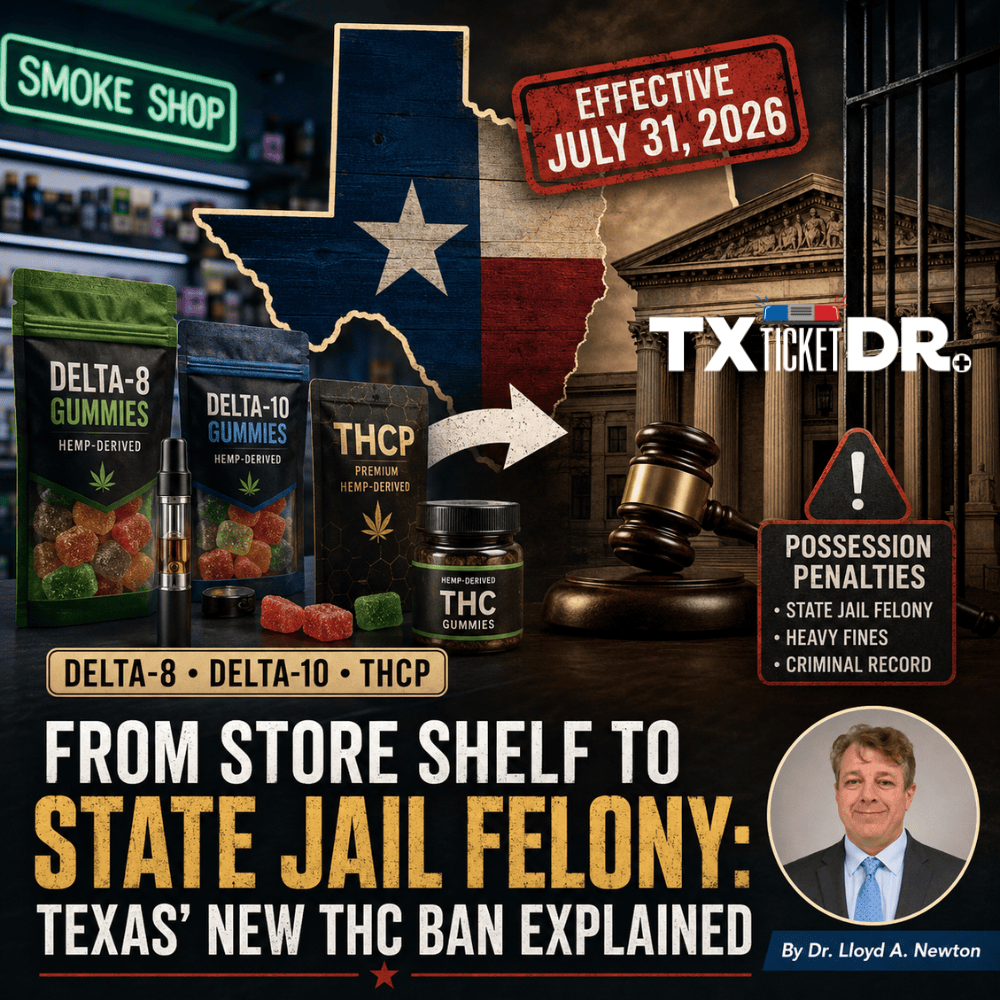
That changed on July 31, 2026.
Texas has reinstated controlled-substance definitions that treat many hemp-derived THC products as illegal drugs. A product that was openly displayed on a store shelf only days ago could now expose the person carrying it to a felony drug charge.
I understand how confusing and unfair that may feel. Many people reasonably assumed that a product was legal because it came from a licensed business, was professionally packaged, and included a laboratory report.
Unfortunately, those facts do not necessarily prevent an arrest under the new rules.
Here is what Texas drivers, consumers, parents, and business owners need to understand.
What Changed Under the New Texas THC Ban?
This change did not come from a completely new law passed on July 31. It came from a long-running court fight over how the Texas Department of State Health Services, commonly called DSHS, classifies certain forms of THC.
In 2021, DSHS attempted to classify manufactured delta-8 THC and similar THC variants as Schedule I controlled substances. A court order temporarily prevented the state from enforcing that position, which allowed delta-8 products to remain widely available for several years.
On May 1, 2026, the Texas Supreme Court cleared the way for DSHS to reinstate its controlled-substance definitions. The updated scheduling action became effective July 31, 2026.
DSHS now states that only naturally occurring trace amounts of delta-8 THC in a hemp plant are exempt from controlled-substance status. Products labeled as containing delta-8, or shown through testing to contain more than trace amounts of prohibited THC variants, may be detained and referred to law enforcement.
In practical terms, many concentrated or manufactured THC products that were previously sold across Texas are now considered illegal.
Which THC Products Are Now Illegal in Texas?
Products that may fall under the new prohibition include those containing:
- Delta-8 THC
- Delta-10 THC
- THCP
- Other chemically converted or manufactured THC isomers
- Products containing more than trace amounts of prohibited tetrahydrocannabinols
- Products containing more than the permitted amount of delta-9 THC
These substances may appear in:
- Gummies and other edibles
- Beverages and seltzers
- Tinctures and oils
- Vape cartridges
- Concentrates
- Smokable products
- Chocolates and candies
- Capsules
The package does not need to say “marijuana” for the product to cause a legal problem. Labels such as “hemp-derived,” “farm bill compliant,” or “legal THC” may not accurately reflect how Texas law enforcement will classify the contents after July 31.
The state has also indicated that products containing THCA may face enforcement scrutiny. However, court disputes and legal questions remain concerning certain naturally occurring cannabinoids and smokable hemp products. The exact treatment of a product may depend on its chemical makeup, laboratory testing, and how local police and prosecutors interpret the current rules.
Is Any THC Still Legal in Texas?
The July 31 change is not a complete ban on every product containing THC.
Texas still permits qualifying consumable hemp products containing no more than 0.3 percent delta-9 THC on a dry-weight basis. That means some delta-9 gummies, beverages, tinctures, and other properly manufactured hemp products may remain legal.
However, consumers should be careful.
A product’s legality cannot always be determined by reading the front label. The advertised percentage, actual laboratory results, ingredients, production method, and type of THC can all matter.
A person should not assume a product is legal simply because:
- It is still available in a store.
- It was purchased before July 31.
- The package says it contains hemp.
- The retailer said it was legal.
- It was ordered online from another state.
- It contains less than 0.3 percent total THC.
The commonly discussed 0.3 percent limit applies specifically to delta-9 THC measured on a dry-weight basis. It does not necessarily legalize manufactured delta-8, delta-10, THCP, or every other intoxicating cannabinoid.
What Are the Texas Penalties for Possessing Banned THC?
Possession of an illegal THC product may be prosecuted under Penalty Group 2 of the Texas Controlled Substances Act.
The possible charge generally depends on the alleged weight:
- Less than one gram: State jail felony
- One gram to less than four grams: Third-degree felony
- Four grams to 400 grams: Second-degree felony
- More than 400 grams: Enhanced first-degree felony punishment
A state jail felony may carry 180 days to two years in a state jail and a fine of up to $10,000. A third-degree felony may carry a sentence of 2 to 10 years in prison. A second-degree felony may carry a sentence of 2 to 20 years. Larger quantities can expose a person to far more severe punishment.
This is where gummies, brownies, beverages, and other infused products can become especially dangerous from a legal standpoint.
Texas controlled-substance cases may be based on the aggregate weight of the substance, including adulterants and dilutants. Depending on the product and the prosecution’s theory, the state may attempt to use more than the weight of the active THC alone.
For example, the amount of THC inside a package of gummies may be small, but the total weight of the gummy mixture could be much higher. Laboratory testing, the charging decision, and the specific facts of the case can make an enormous difference.
Every case needs to be examined carefully. A label or police estimate should not automatically be treated as conclusive proof of the substance or its weight.
Can You Be Charged for a Product Purchased Before July 31?
Possession is generally judged based on when the person allegedly possessed the substance, not only when it was purchased.
That means keeping a receipt showing that you bought delta-8 gummies before July 31 may explain how you obtained them, but it may not prevent a charge if police find them after the new schedule took effect.
The state would still need to prove the legal elements of possession. That normally includes showing that you knowingly or intentionally exercised care, custody, or control over the substance.
That can create important questions when a product is found:
- Inside a vehicle used by several people
- In a shared home
- In someone else’s bag
- In a hotel room
- Inside a package with unclear labeling
- Near several occupants during a traffic stop
Being close to a substance does not always prove legal possession. The state generally needs evidence connecting the accused person to the item.
What Should You Do If Police Find a THC Product?
Do not argue with the officer or try to explain the chemistry on the side of the road.
You have the right to remain silent. You can provide the legally required identification and information during the encounter without answering investigative questions about where the product came from, who owns it, or whether you used it.
Avoid making statements such as:
- “I bought it legally.”
- “It’s only delta-8.”
- “Those gummies are mine.”
- “The store said it was under the limit.”
- “I did not know the law changed.”
Those statements may be used to establish knowledge, ownership, or control.
You should also avoid consenting to a search without first understanding your rights. Whether officers already have legal grounds to search is a separate question, but voluntarily giving consent can make a later challenge more difficult.
If you are arrested, cited, or told that charges may be filed, speak with a Texas criminal defense attorney before discussing the case with police, prosecutors, retailers, or insurance representatives.
A THC Arrest Does Not Automatically Mean a Conviction
An accusation is only the beginning of a criminal case.
Depending on the facts, a defense attorney may examine:
- Why the officer stopped or contacted you
- Whether the search was legal
- Whether you consented to the search
- Where the product was found
- Who had access to the location
- Whether the state can prove knowing possession
- Whether the laboratory properly identified the substance
- Whether the product contained a prohibited THC variant
- How the state calculated the weight
- Whether the testing methods were reliable
- Whether statements were obtained legally
- Whether the evidence was properly stored and handled
The recent change also creates the possibility of confusion among consumers, retailers, officers, laboratories, and prosecutors. That does not guarantee that a case will be dismissed, but it does make a careful investigation especially important.
Do not plead guilty simply because the product came from your vehicle or because an officer said the substance was illegal.
Frequently Asked Questions About the Texas THC Ban
Is delta-8 THC now illegal to possess in Texas?
Manufactured delta-8 products containing more than naturally occurring trace amounts are now treated as controlled substances under the Texas schedule that took effect July 31, 2026. Possession may lead to a felony charge.
Can I legally possess delta-9 gummies in Texas?
Some hemp-derived delta-9 products may remain legal when they contain no more than 0.3 percent delta-9 THC on a dry-weight basis and comply with other Texas requirements. However, packaging alone may not establish that a product is legal.
What happens if I bought delta-8 before the ban?
Buying the product before July 31 does not necessarily make continued possession legal after the new controlled-substance schedule took effect. Keep any packaging and receipts, do not destroy evidence after learning of an investigation, and speak with an attorney about your specific circumstances.
Get Help With a Texas THC Possession Charge
The most troubling part of this change is how quickly an ordinary purchase can become the basis for a serious criminal accusation.
You may have bought a professionally packaged product from a legitimate Texas business. You may not have known the state’s position had changed. You may not even know which form of THC the product actually contains.
You still have rights, and the state still has the burden of proving its case.
I help Texans understand the charge against them, examine how the evidence was obtained, and determine what legal options may be available. Every situation is different, so the sooner I can review the facts, the better prepared we can be to address the case.
Contact Dr. Lloyd A. Newton, Texas Ticket Doctor, today for help with a Texas THC possession charge. Call 210-210-1616. Se habla español.
This article is for general information only and is not legal advice. Every case is different, so speak with a qualified attorney about your specific situation.

 From Concern to City Hall: A Lawful Guide to Challenging Flock Cameras